
Learn Crypto Mining in simple terms, how mining works, Proof of Work, mining hardware, rewards, costs, profitability, and the risks beginners should know.
Cryptocurrency can appear almost out of nowhere.
You see new Bitcoin entering circulation, transactions being confirmed, and blocks continuously added to a blockchain. But who actually does all that work?
For cryptocurrencies that use Proof of Work, the answer is miners.
Crypto Mining is the process of using computing power to help verify transactions, add new blocks to a blockchain, and maintain the security of the network. In return, miners can receive rewards for the work they perform.
The word “mining” makes it sound like you’re digging for digital coins. In reality, there are no virtual coins buried inside a computer.
Instead, miners use specialized machines to perform enormous numbers of calculations.
If you’re new to cryptocurrency, here’s what you actually need to know about how mining works, what miners need, how they make money, and why mining has become much more difficult than it was in Bitcoin’s early days.
What Is Crypto Mining?
Crypto Mining is a process used by Proof-of-Work blockchains to verify transactions and add them to the blockchain.
Miners compete to solve a computational puzzle. The miner that finds a valid solution gets the opportunity to add a new block to the blockchain and receive the network’s available rewards.
This process serves a purpose beyond creating new coins.
It also helps protect the blockchain from fraudulent activity and makes it difficult for someone to rewrite previous transactions. Bitcoin’s developer documentation explains that changing an earlier block would require repeating the proof of work for that block and the blocks that follow it.
Why Do Cryptocurrencies Need Mining?
A traditional bank keeps track of transactions and decides which transactions are valid.
A decentralized cryptocurrency doesn’t have one central bank doing that job.
Mining provides a way for participants to reach agreement about which transactions should be included in the blockchain. Miners verify transactions, package them into blocks, and compete to add those blocks to the network.
That makes mining an important part of how Proof-of-Work cryptocurrencies operate.
How Does Crypto Mining Work?
The actual process is technical, but the basic idea is surprisingly easy to understand.
When people send transactions, those transactions are broadcast to the network. Miners collect valid transactions and organize them into a potential block.
Their computers then perform calculations looking for a valid result that satisfies the network’s requirements.
This involves repeatedly changing a value called a nonce and calculating hashes until a suitable result is found.
The miner who finds the valid result can broadcast the block to the network. Other participants can quickly verify the solution before accepting the block.
What Is Proof of Work?
Proof of Work, often shortened to PoW, is the consensus mechanism behind Bitcoin mining.
The name makes sense when you think about what miners are doing. They have to demonstrate that they performed a significant amount of computational work before they can add a block.
The calculations themselves aren’t solving a useful mathematical problem in the traditional sense. Their purpose is to make block creation costly in terms of computing resources while making the resulting proof easy for the network to verify.
This helps protect the blockchain from attacks and dishonest attempts to manipulate its history.
What Do Crypto Miners Actually Earn?
Mining rewards are one of the main reasons people are willing to spend money on hardware and electricity.
A miner that successfully adds a block can receive a combination of newly issued cryptocurrency and transaction fees, depending on the blockchain’s rules.
Bitcoin is a good example.
Its block subsidy has decreased through periodic halving events. As of the April 2024 halving, the Bitcoin block subsidy became 3.125 BTC per block.
That doesn’t mean every miner receives 3.125 BTC.
Miners compete for blocks, and many participate through mining pools where rewards are distributed among participants according to their contributed computing power.
What Are Transaction Fees?
People who use a blockchain may pay transaction fees.
These fees can become part of the reward available to miners when their transactions are included in a block.
This becomes increasingly important for Bitcoin because the number of newly created bitcoins decreases over time.
Eventually, Bitcoin’s new issuance is expected to reach zero, meaning miners will rely on transaction fees rather than newly created BTC for the block subsidy.
What Hardware Is Used for Mining?
Mining equipment has changed dramatically over the years.
In Bitcoin’s early days, people could experiment with ordinary computers. As competition increased, miners moved to more powerful hardware.
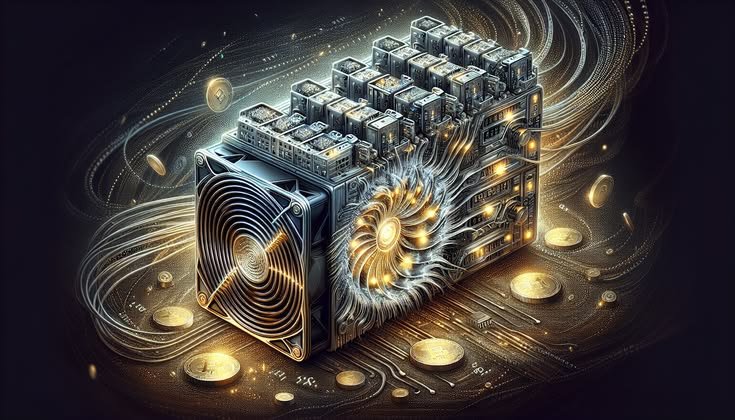
Today, serious Bitcoin mining is dominated by specialized machines called ASICs, or application-specific integrated circuits.
These machines are designed specifically for mining a particular algorithm.
They are much more efficient at the required calculations than a typical home computer, which is one reason large-scale mining operations have become so common.
Can You Mine Crypto With a Normal Computer?
Technically, some cryptocurrencies can still be mined using consumer hardware.
But Bitcoin is a different story.
The network has become extremely competitive, and modern Bitcoin mining generally requires specialized equipment and access to relatively inexpensive electricity.
Running a basic computer at home and expecting it to compete profitably with industrial-scale mining operations isn’t realistic in most situations.
What Is a Mining Pool?
Mining alone can be difficult because your machine may go a long time without successfully finding a block.
That’s where mining pools come in.
A mining pool allows multiple miners to combine their computing power. The pool works collectively toward finding blocks, and rewards are then distributed among participants according to the pool’s rules and their contribution.
This makes payouts more regular and predictable than trying to mine completely on your own.
For many individual miners, joining a pool is more practical than competing against the entire network with one machine.
What Determines Mining Profitability?
This is where Crypto Mining gets much more interesting.
Mining isn’t automatically profitable just because you receive cryptocurrency.
You have expenses.
The biggest ones are usually electricity and hardware. Depending on the operation, there can also be costs for cooling, internet service, maintenance, space, staff, and equipment replacement.
Coinbase’s mining guidance points to several major profitability factors, including electricity costs, hardware efficiency, mining difficulty, and the market value of the cryptocurrency being mined.
Electricity Costs
Electricity can make or break a mining operation.
Mining machines may run continuously, which means they can consume significant amounts of electricity.
Two miners using the same hardware could have completely different results if one pays substantially less for power.
That’s why large mining companies often search for locations where electricity is relatively inexpensive.
Mining Difficulty
Mining networks adjust difficulty to keep block production around their intended target.
As more computing power joins the network, competition can increase. Bitcoin automatically adjusts its mining difficulty every 2,016 blocks, roughly every two weeks, to help maintain an average block time of about 10 minutes.
This means you can’t simply buy a faster machine and assume your profits will stay the same forever.
The rest of the network is changing too.
Cryptocurrency Price
The value of the coins you’re earning obviously matters.
If your mining costs remain the same while the cryptocurrency’s market price falls, your potential revenue can shrink.
The opposite can happen when the asset’s price rises.
That’s why mining economics can change quickly. A setup that looks attractive at one price may become unprofitable after a major market move.
Is Crypto Mining Still Profitable?
It can be, but profitability depends heavily on the specific situation.
Large professional mining operations have advantages that individual hobbyists may not have. They can purchase hardware in bulk, negotiate electricity contracts, optimize cooling, and operate machines at scale.
For someone mining from home, electricity costs and hardware expenses can make the numbers much harder to justify.
Before buying equipment, calculate the expected revenue and subtract all your costs.
Don’t look only at the potential coin reward.
What Is Cloud Mining?
Cloud mining allows people to rent computing power from a company instead of purchasing and operating their own mining equipment.
The provider handles the hardware and infrastructure, while the customer pays for an agreed amount of mining capacity. Any resulting payouts depend on the contract and provider’s terms.
The idea sounds convenient because you don’t have to deal with noisy machines, heat, maintenance, or electricity directly.
But cloud mining comes with its own risks.
You need to research the provider carefully, understand its fees and contract terms, and be cautious of unrealistic profit promises.
What Are the Main Risks of Mining?
Mining involves more than simply turning on a machine.
Hardware can become outdated. Electricity prices can change. Cryptocurrency prices can fall. Mining difficulty can increase.
There’s also the possibility that your equipment breaks down or needs to be replaced sooner than expected.
Hardware Costs
A serious mining setup can require a substantial upfront investment.
And mining hardware doesn’t last forever.
Newer and more efficient machines can enter the market, making older equipment less competitive.
If you’re calculating potential returns, remember to account for the original cost of your equipment rather than treating the hardware as free.
Heat and Noise
Mining machines generate a lot of heat and can be extremely noisy.
That’s not a minor issue if you’re thinking about running equipment inside your home.
You need appropriate ventilation and a safe electrical setup. Larger operations often require dedicated cooling and infrastructure to keep machines running reliably.
Crypto Mining and Energy Use
Energy consumption is one of the most debated parts of Proof-of-Work mining.
Mining requires substantial computing power, and that computing power requires electricity.
This has led to criticism over the environmental impact of some mining operations.
At the same time, the environmental impact can vary depending on where miners operate and what energy sources they use.
The important point is that Proof of Work deliberately requires real-world resources. That resource cost is part of the security model, but it is also one of the system’s biggest trade-offs.
Crypto Mining vs. Crypto Staking
Mining and staking are sometimes confused because both can help secure blockchain networks.
They work very differently.
Mining is associated with Proof of Work and relies on computational power.
Staking is associated with Proof of Stake and relies on participants committing cryptocurrency to the network.
Ethereum is a useful example. Ethereum moved away from mining and Proof of Work and now uses Proof of Stake, where validators participate by staking ETH instead of competing through mining hardware.
So if you hear someone talking about “Ethereum mining” today, they’re usually referring to Ethereum’s historical Proof-of-Work system rather than how Ethereum currently operates.
Is Crypto Mining Right for Beginners?
That depends on your goal.
If you’re simply curious about how blockchain technology works, learning about mining can be extremely useful.
Actually purchasing mining equipment is a different decision.
Before spending money, understand the hardware requirements, electricity costs, expected rewards, network difficulty, maintenance expenses, and potential resale value of the equipment.
Most importantly, don’t assume mining is an easy way to make passive income.
The economics can be surprisingly competitive.
Final Thoughts on Crypto Mining
Crypto Mining is much more than a way to create new digital coins.
For Proof-of-Work networks such as Bitcoin, mining helps verify transactions, add blocks to the blockchain, and protect the network from manipulation.
Miners compete using computing power, and successful miners can receive block rewards and transaction fees.
But modern mining is a serious business for many participants. Specialized hardware, electricity costs, network difficulty, cryptocurrency prices, and competition all affect the final result.
For beginners, the smartest place to start isn’t with buying a mining machine.
Start by understanding how Proof of Work works, why miners are needed, how rewards are calculated, and what the real costs look like.
Once you understand those pieces, you’ll have a much clearer picture of whether mining is something worth exploring further.